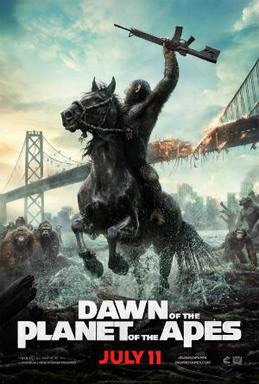
Plot: Ten years after the Simian Flu pandemic wiped out all but one in 500 of the human population that was immune to the disease, a group of humans, including Malcolm (Jason Clarke), and a small group of humans that successfully bond with Caesar (Andy Serkis), who is now the leader of the newer genetically enhanced ape population. When Koba (Toby Kebbell), Caesar’s second-in-command, begins to grow resilient towards humans after he was abused by humans at the Gensys lab, can Caesar successfully allow his new human friends to work on a generator that will likely help bring power to the mini human population in the area?
Okay, now, here is an example of how you do a sequel, and mostly, if not fully, right. First of all, because this sequel had a longer running time than the previous film, 25 minutes longer, to be exact, this film had more room to breathe in terms of developing the world more, developing the characters much more, and even conflicts much more. Even the enmity between Caesar, and Koba was handled really well. Same goes for the ape population overall. Honestly, even though the human characters are newer ones, you really care for them, along with all the ape characters. I wouldn’t be surprised if maybe part of why this film was longer than the previous film was because a lot of other people might have thought the first film to be a little too short. Well, thankfully, that was not the case this time around. It truly deserved to be longer. Oh, and the filmmakers did a phenomenal job of making Koba villainous, and menacing. His face seemed to look a little like that of Scar from The Lion King. Additionally, Caesar served as a great example of a great leader. I mean being willing to fight against those who tried to wreck his leadership, no matter how difficult that would have been for him, giving some of the humans a chance, particularly when one of them helps a family member of his out, and more. I don’t recall this much character development even from him in the first film. Same goes for the newer human character, Malcolm, his wife, Ellie, and even the leader of the remaining humans, Dreyfus. Oh, that reminds me, the acting was great too, especially from Andy Serkis, Jason Clarke, Keri Russell, and Gary Oldman, along with the rest of the cast. If there were any great lessons to learn from this film, it would be that one, to be willing to give others the benefit of a doubt, even if they need to earn your trust, and to not act like you know it all, when you don’t.
Still, while most of the character development was fantastic, there was some that did seem to be lacking, particularly from Dreyfus, the ex-police. I won’t go into details, but let’s just say that with actions that he took near the end of the film, there could have been a little buildup to his character. That leads me to the other deal with the climax. The climax could have been maybe tweaked a little more as well.
And that’s my review for Dawn Of The Planet Of The Apes. Though it still could have been a little better, it was overall really enjoyable. Nearly everything was an improvement from Rise Of The Planet Of The Apes, from the world building, mostly good character development, a surprisingly great musical score by Michael Giacchino, and more. If you want to see a sequel that is an improvement from its predecessor, then definitely check it out. You may yet be pleasantly surprised.
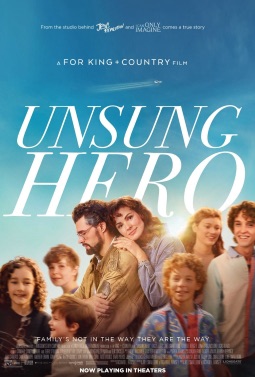
Everyone, before we get into binge watching, and reviewing the four Planet Of The Apes movies that were released from 2011 through this year, in 2024, we shall review a film that was based on actual events. And not just any historical event. It was actually based on a family that became a part of the Christian music industry, and has left an impact on Christians, and, likely even helped lead even non-Christians to The Lord. So, without further ado, let’s discuss Unsung Hero.
Plot: This film chronicles the Smallbone family, their journey from Australia to America in 1991, the struggles they faced along the way, and their slow rise in the Christian music industry.
Wow, what another triumphal entry in mainstream filmmaking, and especially in a day, and age when, despite there being films with lots of violence, sexual innuendos, and things like that, there have also been Christian films on the rise in the mainstream film industry as well. Case in point, Jesus Revolution, I Can Only Imagine, and films like those. So, with all of that said, is Unsung Hero just as good? Without a doubt! To start, people who have enjoyed any of the songs that either Christian artist Rebecca St. James, or For King & Country wrote, will especially love this film. Well, not just people who loved their music, but people who have loved Christian music in general will really come to appreciate this film. However, what makes Unsung Hero stand out is how it wasn’t afraid to show how much the Smallbone family struggled, while navigating living their new life in the U.S. I mean here many of us likely are thinking that people in the Christian artist industry have had an easy life when, in reality, they have also had struggles in their lives too like so many other Christians have. What’s even more is that because Unsung Hero was based on historical events in the Smallbone family’s lives, it may change the attitudes of the non-Christian skeptics, or possibly even Christian ones, that may believe that God doesn’t do miracles even today. Friends, family, and even strangers, watch this film, and I’m sure your skepticism will be shattered by the time you finish up watching this film. Finally, many lessons can be taken from this film, particularly from things such as how the Smallbone was willing to stick together through thick, and thin in every situation, how important it is to move forward when it’s easy to look back, how much we need Jesus, and can’t navigate through lives on our own, being humble, and grateful in every situation, and not prideful, and lessons like those.
And that’s my review for Unsung Hero. If you haven’t seen this film, then this is a must see. The lessons to take away from this film, and basically going on this journey back in time with this film overall alone will make this film worthwhile. If you find all that hard to believe, then all the more reason that you should go into this movie with a curious mind. By the end, I can guarantee that you’ll be glad that you did, whether you are a Christian, or non-Christian. So, try to make time to see Unsung Hero, and see what you think!
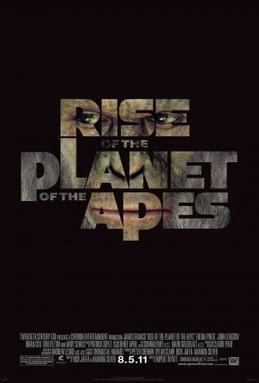
Well, everyone, this is it. Today, we shall start on the newer Planet Of The Apes franchise that began in 2011, and has continued up to this present point. So now, let’s discuss Rise Of The Planet Of The Apes.
Plot: When a pharmaceutical chemist named Will Rodman (James Franco) begins to test a viral-based drug by the name of ALZ-112 at a biotechnology company by the name of Gen-Sys by testing it on an ape, and attempting to cure Alzheimer’s Disease, the test goes awry, causes some of the apes in the lab to go crazy, as well as, eventually, become intelligent. In spite of this, and a plague from the ALZ-113 that starts to cause harm on a lot of the human race, can Will help save the human race, or will the human race be wiped out, and replaced by the now intelligent ape species?
Though the storyline may not be one of the strongest points for this movie, the film does still have other stronger points. First of all, to see Andy Serkis voicing the main ape character, Caesar, how we not appreciate that, especially those of us who enjoyed seeing him voice Gollum in the Lord Of The Rings movies? Yes, unlike in those films, when he played an antagonistic character, he did quite the opposite this time around, but still. And James Franco as main human character Will Rodman, also a great performance. And yeah, same goes for the other performances. Also, there was some really cool action in this film, particularly near the end, when the climax occurred. Also, how we not love, and appreciate the bond that was well developed between Caesar, and Will Rodman, and Dr. Caroline Aranha, who also served as Will’s love interest? The cinematography was also really good, especially of the wilderness, and the view of San Francisco from trees, and mountainous areas. And yeah, there is still some heart to this film, particularly when it comes to the main relationships. Finally, there may be some valuable lessons in regarding using wisdom with how to help others, save lives, and things like that.
Still, the storyline seemed to feel a little lackluster. I mean it felt a little too fast paced, and the film might have been a little too short, giving the film very little time to develop things like relationships, buildup to the climax, and the story overall. Honestly, considering the following three films ended up having a longer running time than this first film, you got to wonder if maybe the filmmakers did in fact realize how much development did seem to be lacking here. Even the ending might have felt a little rushed. Truthfully, I’d say it was a miracle that this film was successful enough to spawn more sequels for this reboot.
And that’s my review for Rise Of The Planet Of The Apes. Even though it may not have been quite a strong start to this newer franchise, it did have some good things to make it enjoyable. For those reasons, the action, and likely being curious to see more of this world after this film, I’d say still it for those reasons alone, if not more. And plus, the only way to go left from here was up. Did they? Well, we shall find out soon.
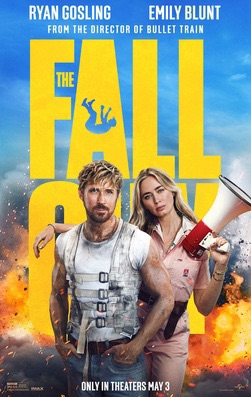
Hi, everyone, and welcome to another session of movie reviewing! Today, we are going to be reviewing an action film that stars Ryan Gosling, and Emily Blunt, along with other people. Not only that, but it’s one of the more rare to fewer films in this days and age that seemed to have more of an original story to it. So how, let’s discuss The Fall Guys!
Plot: When a former movie stunt star named Colt Seavers (Ryan Gosling) is informed by movie producer Gail Meyer (Hannah Waddingham) that a movie star named Tom Ryder (Aaron Taylor-Johnson) has gone missing in action, will he, along with movie director, and ex-girlfriend Jody Moreno (Emily Blunt) be able to to find Tom, and discover what he’s been up to, and still be able to make a science fiction film that Jody has been trying to make for sometime, and that Colt may yet be part of once again?
Well, not only is this an action, as well as one that feels more original at best, it is also a comedic action movie, and one that seemed to work much better than say the movie Argylle that was released back in February of this year. For one, the movie had really clever writing, excellent comedy, likable, and memorable characters, and more. Colt, and Jody’s relationship is most likely one of those relationships that is most likely one of the closest thing to a realistic type. There were also some really clever twists in this film that, along with the other elements, help make The Fall Guy more unique, intriguing, and interesting overall. It also makes for a great satire of what most likely may happen to a lot of celebrities once they gain popularity, and potentially become prideful of the things that they can do. It was also great to learn a little more of what it looks like when you film a movie, the things that are involved in that process, and more. Additionally, David Leitch, who also directed films like Bullet Train two years before this film, did a great job with this film. In fact, The Fall Guy most definitely served as a great improvement from when Leitch direct films like Bullet Train in recent years. As far as Dominic Lewis’ score goes, need I say more? But what really is cool is that one of the ways in which the writing is clever is how this film has a character making a science fiction film, while this film itself ends up also being an action movie itself. It helps make the movie one of the most fun, engaging, and creative ones to come out. Not to mention that we can be glad that this is not a sequel, or even a remake of another movie you know? As for Gosling, and Blunt, they truly have great chemistry with each other. While all the other cast members had fun, it would seem as if those two, in particular, worked well off each other. You can tell that they probably enjoyed working together in this film. And another thing, this was another movie that does well with incorporating comedy in an action film like this one. I mean to have comedy on an action movie, how can you go wrong with that? Finally, there are some good lessons about how pride, and arrogance can skews to downfall, emotionally, literally, and more, to not always be trusting those closest to you, and more.
And that’s my review for The Fall Guy. If you haven’t seen this film, then I would most definitely recommend it. You’d most likely be blown away by how fun this movie is in the end. Because of how great the writing is, you’d find yourself enjoying this film a lot. So, definitely see The Fall Guy, and see what you think!
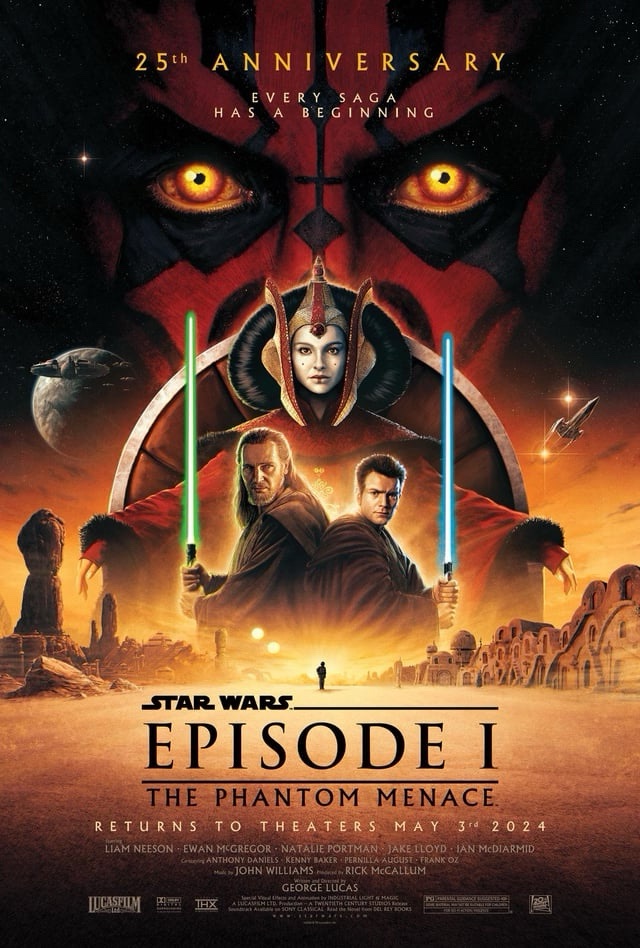
Well, everyone, today, in honor of the very first of the Star Wars prequels getting re-released in theaters, we review the very first Star Wars film that started it all, and set things up not only for the entire prequel trilogy, but also helped the original Star Wars trilogy be explained more in depth, and see some of those characters in the original trilogy be in the prequels in their younger years. Not only that, but this Star Wars film stars Liam Neeson, Ewan McGregor, Natalie Portman, Ian McDiarmid, a young Jake Lloyd at the time as Anakin Skywalker, and more. Ladies, and gentlemen, I give you all my review of the one, and only Star Wars: Episode I: The Phantom Menace. So here we go, back to 1999, and now, 2024, when this film got released, and re-released in those years respectively. By the way, I bet some, if not all of you, wondering why I posted the 25th anniversary poster, instead of the original theatrical poster for this Star Wars film. Well, I did so mainly because of the fact that this film got re-released recently, and I thought it was just fitting to post this newer 25th anniversary poster instead, you know? Don’t worry! You guys can still look online for the original theatrical poster for Star Wars Episode I: The Phantom Menace. Anyway, without further ado, let’s dive into reviewing this film!
Plot: Set thirty years before the events of the original Star Wars trilogy, Finis Valorum (Terence Stamp) the Chancellor of the Galactic Republic, dispatches Jedi Knights Qui-Gon Jinn (Liam Neeson), and Obi-Wan Kenobi (Ewan McGregor) to negotiate with Viceroy Nute Gunray (Silas Carson) in order to prevent a full-scale invasion on the planet Naboo that is organized by two Sith lords named Darth Sidious (Ian McDiarmid), and his apprentice, Darth Maul (Ray Park). When things go south, can the Jedi, with the help of newer friends, including Queen Padme Amidala (Natalie Portman), a Gungan named Jar Jar Binks (Ahmed Best), and a young former slave named Anakin Skywalker (Jake Lloyd), with whom Qui-Gon believes the Force to be strong in, will the Jedi Knights still be able to prevent the full-scale war from occurring on Naboo, and possibly even the rest of the Galaxy?
Now, as I’m sure some of us know, while some critics said positive things about Star Wars Episode I: The Phantom Menace, there were quite a few others that gave negative feedback, saying things like the writing could have been better, some of the acting could have improved, and things like that. So, were some of those criticisms warranted? Well, in some ways, yes, and others, critics may have likely been a little too harsh with Star Wars Episode I. That being said, what were some of the things that could have made this first film of the Star Wars prequel trilogy a little better? Well, first of all, some of the writing could have maybe improved at times, particularly with the story not dragging on occasion, and maybe, sometimes not being a little too fast-paced at one, or two points. As for the acting, while most of the acting is great, Jake Lloyd’s acting for Anakin Skywalker at least could have improved at times. Don’t get me wrong, his acting for Anakin is still decent. It’s just that, well, I’m not sure how to properly explain it, except that either because he was a younger kid at the time, or it just may not have felt quite as genuine as one would like, Lloyd’s acting had a little more potential to be better when it came to playing young Anakin Skywalker. I heard that Jake Lloyd retired from acting a couple years after this film was first released. Did he do so because maybe a lot of other people felt the same way? Well, I obviously can’t advocate for other people, and their opinions. Still, I wouldn’t be surprised if something like that was the case. There was also some of the CGI at least on some of the characters. Okay, I’ll admit that the CGI was better in this prequel, as well as the other two films that followed this one. Still, it may have felt dated by today’s standards, and maybe even back then too. As for the complaint about Jar Jar Binks, he’s definitely a fun character, and deserves more credit than he’s given. Still, there were a couple times where he might have come off as a little annoying, and his goofiness may have been thrown in your face a little too much. Other than that, he’s still likable, like all the other characters in this Star Wars film, or other Star Wars movies.
With those out of the way, what were the good things about this film? Well, the first obvious one was the score by John Williams. Okay, there’s no doubt that his score in nearly any film, be it most of Star Wars, Home Alone, the Indiana Jones films, Jurassic Park, you name it, has been phenomenal. Well, here in Star Wars Episode I: The Phantom Menace is no exception. It is truly an amazing experience to hear the score especially when seeing this film in theaters, most notably during the climax, when Qui-Gon Jinn, and Obi-Wan Kenobi are facing off with Sith apprentice Darth Maul. Honestly, I wouldn’t be surprised if some people might want to purchase the soundtrack of Star Wars Episode I for that “Duel Of The Fates” track alone. Next, there is some really cool action in this Saturday Wars film. Okay, there has always been some great action in these films. And sure, there may be less of it this time around. However, it probably works a little better that way mainly because, well, this is the first Star Wars film after all. Because of that, it was probably best that they focus more on establishing the characters, the world, and more, and less on cool action sequences, huge explosions, and things like that. And hey, at least we can be grateful for what action sequences that this film does have. Next, there is the character development. Wow, particularly with our main characters, this is where the movie in this area shines. To begin, who wouldn’t consider Obi-Wan Kenobi, and Qui-Gon Jinn to be the most memorable Jedi, and characters overall, in this one Star Wars film, especially since this was the only film that we get to see the latter in? Anakin was also a likable character, despite the actor’s acting for him not quite being the best. Even here, we can sense some of his cockiness, and potential foreshadowing of his future transformation into the evil Darth Vader. Okay, if you think that’s spoilers, then don’t forget that the back of the VHS of this film years ago would point out that “the journey that he’s on will transform him into the evil Darth Vader”. Well, with that kind, hopefully people who still desire to see Star Wars will desire to do so. The secondary characters were also very good, like Anakin’s mother, Shmi, Watto the flying alien that owned both Anakin, and Shmi as slaves, Sebulba, despite most of them having smaller roles in this film. But probably one of the best developed characters, in addition to Qui-Gon Jinn, Obi-Wan Kenobi, and Anakin Skywalker is definitely Senator Palpatine/Darth Sidious. Okay, when I saw this film as a kid, I don’t recall hearing that he was supposed to be the Sith Lord, and future evil Emperor of the Galactic Empire. Not until it was noted on the back of the old VHS of this film that Palpatine was “well known as the evil Emperor”. So, because of that, I ignorantly thought him to be a good character, just like Anakin Skywalker, as he mentioned in Star Wars Episode II: Attack Of The Clones, also did. However, after rewatching this film again for the first time in years, yeah, it’s probably easy to foreshadow his sly, and cunning nature. Palpatine is truly a representation of someone masquerading as an angel of light. He’s sly, cunning, deceptive, manipulative, and someone who will do whatever he can to get into power. Next, there is some of the CGI for this time around. I mentioned earlier that some of it was a little outdated by today’s standards. However, after seeing this 25th anniversary edition in theaters, I was happy to see hie much some of it improved, most notably by how Yoda looked this time around. I remember when this film came out back in 1999, him looking like a puppet, and him not having the best CGI because of that. Well, apparently many people seemed to also feel that way, as his design was then changed for the better in Star Wars Episode II: Attack Of The Clones, and Star Wars Episode III: Revenge Of The Sith. Well, he looked exactly the way that he did in those Star Wars films this time around, for the 25th anniversary edition of Star Wars Episode I: The Phantom Menace. So, well done on that, filmmakers! There are also a couple very heartfelt moments in this movie as well that needed some time to play out. So, even if those might have dragged a little as well, it worked out for the best for those moments. Those emotional moments do know how to tug at your heartstrings. Additionally, like with all the other Star Wars movies, there was incredibly well-written symbolism incorporated into this film. Here, it especially seemed evident with Qui-Gon being a really great mentor, and an overall wise person, the Jedi being a force of good, vice versa for the Sith, and things like that. There were also really great lessons to take away, and be reminded of, like how things don’t happen by coincidence, how you need to be careful of who you should listen to, and not listen to, and more. Finally, there were some really funny moments in this film as well.
And that’s my review for Star Wars Episode I: The Phantom Menace. Even though some of it could have been better at times, this Star Wars film most definitely deserves more credit than it seems to have been given. Despite some of the acting feeling a little off, Jar Jar being a little too goofy at times, and things like that, the movie is an overall enjoyable experience. That is especially due to its phenomenal score, a very good storyline, and more. If, for some reason, you still have yet to see Star Wars Episode I: The Phantom Menace, then go see it. You will be glad that you did. Go see it at your local theater, if it’s still playing near you. You’ll most definitely be surprised by how fun it is to get a theatrical experience for this film. And hey, let’s hope that, maybe minus Episodes VII through Episode IX, we get to see the rest of the Star Wars films back in theaters like we did Phantom Menace.
Final Grade: B
P.S. Happy 25th to Star Wars Episode I: The Phantom Menace come this Sunday, on May 19th!
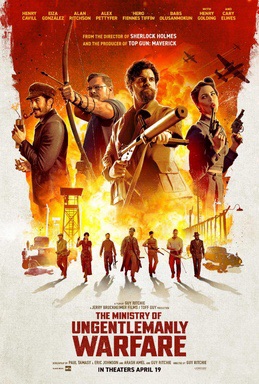
Alright, everyone, today, we review a film that was based on actual events that occurred during at the height of WWII, in 1941. It also seemed yo portray these events in a creative, and comedic way. Now, starring Henry Cavill, and the gang, let’s discuss The Ministry Of Ungentlemanly Warfare.
Plot: This film depicts how, in 1941, at the height of WWII, Winston Churchill (Rory Kinnear) deployed a group of black-ops military men, led by Gus March-Phillips (Henry Cavill), and two SOE agents (Eliza Gonzalez, and Babs Olusanmokun) to go on a special covert mission, known as Operation Postmaster, in an attempt to stop the Nazi Germany from taking over all of Europe. Did Churchill, and his team succeed in the end?
So, was this film successful in retelling the event that occurred during this period in history? Well, yeah, very much so. Granted, like many films that are based on historical events, The Ministry Of Ungentlemanly Warfare did also take quite a few liberties. And yes, this film may have also over exaggerated certain aspects of history. Even so, the movie did well with most likely being accurate to a part of history as possible. What’s really interesting, though, is that, much like films such as 2004’s Hidalgo (which was also based on a true story), The Ministry Of Ungentlemanly Warfare seemed to be a film that acted like an adventure, and action film as well. Who knows? Maybe it worked better for this film than a film like Hidalgo. Maybe I should rewatch that one to say for sure. But anyway, what makes this movie even more enjoyable is the comedy in this film. Honestly, it was interesting how entertaining this film was, especially one that was based off of historical events. The acting was also really good, from Henry Cavill, Til Schweiger, as one of the villains of this film (which, I was surprised to discover that the actor himself is German), Eliza Gonzalez, Babs Olusanmokun, and more. Honestly, for the casting, the people sure seemed to do well with choosing wisely, when it came to them choosing who would play this character, and that one. Christopher Benstead also did well with the score that he composed for this film. It truly had that German music kind of feel, and helped make this movie either sad, or fun, and upbeat at other points. This movie also has a great amount of clever comedy, and comedy that is perfectly timed too. What’s also great is that, for a rated R film, this movie is more lighthearted on at least sexual humor, and scenes. Sure, this film was really violent at points. Even so, had it not been for this film being as violent with was, The Ministry Of Ungentlemanly Warfare could have probably gotten away with a PG-13 rating. Finally, it was cool to learn some really fascinating facts about WWII, and certain events that occurred during that time period. Not to mention that there are some facts about some of the individuals that may, or may not come as a surprise for some people.
And that’s my review for The Ministry Of Ungentlemanly Warfare. It is a fun film that based on a true story, has some good action, and more. Yes, the film may take quite a few liberties with the events that surrounded it. I would say that if you’re curious to learn newer information about WWII, enjoy good comedy, and a great action film that is based on a true story, then all the more reason to see The Ministry Of Ungentlemanly Warfare. You’ll love it for the history of it, and more. Hopefully, this film will become more popular among the audience very soon!
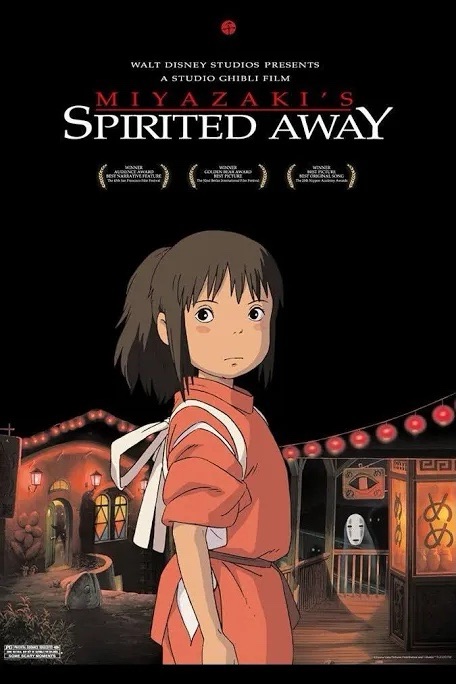
Well, everyone, today, we review a type of animated film that I just reviewed 5 1/2-6 months ago. You may recall that it was a fantasy film from Studio Ghibli by the name of Kiki’s Delivery Service, yes? Well, this time around, not only are we reviewing another animated/anime film from that studio, but we are reviewing one that was released around late 2002, at least in the U.S., and then won an Oscar for Best Animated Feature when the Oscars ceremony occurred that following spring in 2003. Not to mention that this particular film from the studio to win that award until The Boy & The Heron was released this past Christmas, and became the second Studio Ghibli film to do so. Yes, that is correct! Today, we are going to be talking about the one, and only Spirited Away.
Plot: Ten-year-old Chihiro (Daveigh Chase), and her parents, Akio (Michael Chiklis), and Yuko (Lauren Holly) move into a new area of town. Before heading to their new home, they decide to take a detour to an area of open space, and an empty restaurant that is filled with food. But when her parents eat some of the food that she refused to eat herself, she discovers that the area they are in is filled with spirits, witches, and all sorts of other creatures, and that the food caused her parents to turn into pigs. With the help of a new friend named Haku (Jason Marsden), will Chihiro be able to get her parents back to normal, and be able to leave the area that she, and her parents started spending time in?
Now, again, as mentioned before, this was, for a long while, the only anime, and Studio Ghibli movie to win an Oscar for Best Animated Feature. That is until The Boy & The Heron would come out a little over 20 years later, and win awards like the Golden Globe, and Oscar for Best Animated Feature. So, the question remains, did Spirited Away for sure deserve the Oscar for Best Animated Feature, or should one of the other nominations, be it Ice Age Spirit: Stallion Of The Cimarron, Lilo & Stitch, or Treasure Planet, won instead? Well, honestly, I will say that Spirited Away was probably the more imaginative one of the bunch that was released back in 2002. Now, don’t get me wrong, those four were all good to one degree, or another. Granted, as far as at least Ice Age, Spirit, Lilo & Stitch, and Treasure Planet went, I will admit that I probably liked Lilo & Stitch slightly less than those. I still liked it, but I felt like Ice Age, Spirit: Stallion Of The Cimarron, and Treasure Planet did some things a little better than it. Even so, 2002 was undoubtedly one of the better years in the 2000s decade for animated films. Sorry, I’m starting to get off topic, and need to get back, since this review is about Spirited Away. So, out of those five nominations, why did Spirited Away end up being the one to win the Oscar for Best Animated Feature that year? Well, there are a few reasons for sure that one can probably come up with. For one, there is the animation just like in most other Studio Ghibli. Whether the characters are moving slowly, or rapidly, the animation for them, and the backgrounds is surprisingly phenomenal. What’s even more is that Studio Ghibli seems to do a better job of making movements, and maybe even backgrounds more smooth in their Japanese animation than most other anime TV shows, and movies. Spirited Away is no exception. Next, there’s the storyline. Again, the storyline in many Studio Ghibli does well with having good stories, and avoiding many cliches that are found in most mainstream films, specifically that get released in the U.S.. For Spirited Away, that happens to work well in its favor. I mean with how the story is creatively set up, how events get processed, and more, the story is really, really executed. Finally, the story helps get messages portrayed in the most creative ways possible, and executes them well. What’s more is that all of the characters are likable in this film, including Chihiro, who was surprisingly voiced by Daveigh Chase, the same child actress, at the time, that voiced Lilo in Lilo & Stitch (which, of course, was released earlier that year). What’s more is that both characters act rather bratty at first, and do end up growing as characters. Still, it would seem as if Chihiro seemed to mature more mentally than Lilo, and learn better lessons in the process. As for the rest of the cast, be it Haku, Chihiro’s parents, the villain, Yubaba, No-Face, and the rest of the characters have some of the most memorable moments in animated films, even those ones that we get to see less of in this movie. Finally, there are some really interesting twists, particularly around the middle, and end of the film that help make this film even more intriguing, and engaging.
And that’s my review for 2002’s Spirited Away. Looking back, did this film deserve to win the Oscar for Best Animated Feature instead of say Ice Age, Lilo & Stitch, Treasure Planet, or Spirit: Stallion Of The Cimarron? Well, let me put it to you all this way! Those other four films were really creative, interesting, and well-made to one degree, or another. Still, it would be safe to say that Spirited Away ended up being the more imaginative, and creative one of the five. Because of that, Spirited Away undoubtedly getting the Oscar, due to its storyline, the film’s subject matter, really well-written characters, a fun score, and more. It’s just interesting that no other Studio Ghibli film would win this award until 2023’s The Boy & The Heron. That being said, if you haven’t seen Spirited Away, then I would highly recommend it. You are most definitely going to have fun with it. So see it, and see what you think!
Well, everyone, today, we review an animated sequel that was just re-released in theaters for it’s 20th anniversary as of recently, and one of the main reasons that I wanted to rewatch the first film, and review because of that. It also, like its predecessor, got nominated for Best Animated Feature. However, unlike the first film, this sequel lost to a Disney/Pixar film that was released near the end of this same year, by the name of The Incredibles. So now, let’s discuss the sequel to the legendary 2001 animated film that took many people by surprise, the one, and only Shrek 2.
Plot: When newlyweds Shrek (Mike Meyers), and Fiona (Cameron Diaz) are invited by the King, and Queen of Far Far Away (aka Fiona’s parents, and played by John Cleese, and Julie Andrews respectively) to come to their kingdom, and receive their blessing for their marriage, Fiona, and Shrek agree to do so (albeit reluctantly for the latter). Shrek, Fiona, and Donkey (Eddie Murphy) arrive, only to discover that it doesn’t end up being smooth sailing, thanks to a series of mishaps occurring, including King Harold hating the fact that Fiona married an ogre, instead of Prince Charming (Rupert Everett). So now, the question remains, will Harold, and Queen Lillian warm up to Shrek, and the fact that Fiona remains an ogre, or will they do everything in their power to destroy their marriage?
Now, I remember that though there have been some who said that they liked the first film more than this, or any of the other sequels that followed, I’ve heard quite a few others that said that they have at least considered Shrek 2 better than the first film. So, would either statement be accurate? Well, for sure, the second statement would probably ring more true. Now, don’t get me wrong, Shrek 1 is still a good film. However, because the first film was a little too crude, and a little creepy at a couple points, you may recall that I docked the film down to an A- as a result. As for this second Shrek film, though it may have a little bit of crude humor like in the first film, it toned that aspect down by a lot. Because of that, though I still think that The Incredibles was the better film of this, and any other nominations from 2004, there is a part of me that would have felt more peace if Shrek 2 won that Oscar than when the first Shrek film beat out even Monsters, Inc. For one, though the humor is still a little more crude at times, it is more clean, and less raunchy this time around. Next, there’s the storyline. Usually, with some rare exceptions here, and there, sequels don’t usually end up being as good as the first film. This time around, much like other rare cases such as Toy Story 2, or Kung Fu Panda 2, for instance, Shrek 2, strangely enough, ends up being better than the first Shrek movie. Once again, this another example of a movie that pokes fun at Disney, and fairytales. I mean the way that DreamWorks was trying to make a twist on the classic fairytale trope, they pulled it off beautifully well just as much, maybe even more than they did in the first film. Next, there are the characters, old, and new. Once again, Shrek, Fiona, and Donkey, shine as main characters for this film. That being said, the newer characters are also great. From Fiona’s parents, to the fairy godmother, and her son, Prince Charming, and, especially the best of them all, Puss In Boots, who was voiced by Antonio Banderas, every moment with them all remains classic, and memorable. What’s even more is that because Antonio Banderas is the actor to play Puss In Boots, he makes his character have a Zorro like character. So, because of that, Puss In Boots was an excellent new addition to Shrek, and Donkey, as well as a welcome one to the franchise period. Not to mention that it’s awesome that Puss In Boots has a couple of his own movies with him as the main character. As for the soundtrack, it was an upgrade from the first film as well. I mentioned in my review for the first Shrek that most of those songs felt like montage after montage for that film. This time around, even though most of those songs were songs that we had heard before this movie was released, they worked much better this time around. The reason being is that they fit much better with scenes that occurred throughout this film, which is more than we can say about most of the songs from the first film. And plus, who probably didn’t love the fairy godmother character singing the rendition of “Holding Out For A Hero” by Bonnie Tyler around the climax of this film, or even all of the characters singing “Livin’ La Vida Loca” at the very end, for example? The score by Harry Gregson-Williams was also really good. The animation was also really great, maybe even an upgrade from the first film. Shrek 2 was also really funny, and, again, in better ways than the first movie. Finally, this film had some surprisingly good messages that I don’t know how to put words to this time around. Let’s just say that they’re really good.
And that’s my review for Shrek 2. Honestly, even after rewatching this film, when it was re-released in theaters 20 years later, I can see why this sequel is enjoyed by many. It was most definitely an improvement from the first film. The storyline is great, the characters, old, and new, are all likable, and memorable, in fact, maybe even more so this time around, the soundtrack, and score, are awesome, the animation is really great, and the storyline, overall, is really fun. I would say that if you surprisingly have never seen this sequel to the first Shrek movie even 20 years later, I would most definitely recommend it. You would be surprised by how enjoyable it is in the end. So, because of that, you won’t be disappointed. Therefore, give Shrek 2 a shot!
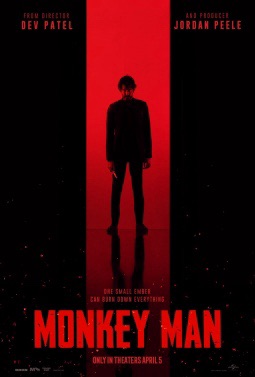
Everyone, today, we review a thriller that starred Dev Patel, Jordan Peele, and some other people. It was released earlier this month. So now, let’s discuss Monkey Man.
Plot: In the jungle forest of India, a young boy named Kid (Jatin Malik) witnesses the murder, and massacre, of his family by corrupt authorities. Now, as an adult, and wearing a mask of a monkey during fights, he fights in boxing at an underground pub called Tiger’s Temple. Now, will adult Kid (Dev Patel) have the money from those fights to be able to settle a score with those who, for a long while, wrecked his life?
Well, I will say that Monkey Man does have a very good storyline. For a man in India, especially to rise from a lower class, and trying to make his way to the top, it was definitely good for this film to show how difficult life can be for people who live in nations like that. Not to mention that the main character, Kid, was willing to work as hard as possible to get to where he needed to be. Granted, his motives may not have exactly been the best, but still. Still, this film does do a great job of showing how people are willing to go to take vengeance on others when they most likely don’t have Jesus in their lives. Yes, from time to time, Christians can also make mistakes, and get lost in things like vengeance, bitterness, and things like that. But yeah, possibly another topic for another time. Anyway, the action, though way too violent at times, was very good, most notably when it came to flashback scenes that occurred throughout this film, and even the climax of this film. As for the scenery of places like some of the jungles of India, some of the temple designs, or even the villages, definitely talk about some of the best cinematography that a movie could have. It was also to get some potential surprise messages, such as how taking revenge is never a good thing, even if that message could have been executed a little better.
So, with those things out of the way, what downsides did this film have? Well, for one, the New Age stuff with the whole religion of India, and that whole mumbo jumbo deal seemed to be thrown in your face a little too much. Also, this film seemed to be way too violent at points. Honestly, at times, part of me felt a little surprised that Monkey Man was rated R, and not say NC-17, or something like that. Additionally, there were some moments near the end, especially the climax, that could have been handled, and executed better than they were in the end. Finally, Kid, the main character of this movie, could have definitely had a bigger, and better character arc than what he had in the first place.
And that’s my review for Monkey Man. Is it a bad film? No! In fact, adults, and maybe teenagers will for sure enjoy this film. Still, some people may find themselves wanting to watch other action films a little more than this one. That being said, Monkey Man isn’t a bad film. Even so, it could have improved. But hey, movie makers in Hollywood don’t seem to believe in relaying more uplifting, and positive messages in their films as of nowadays, do they? Well, all the more reason to be grateful for the fewer times that they do portray the more positive messages in their films. I would say that because it has a fairly good storyline with some good action, likely still see it. Just don’t expect a feel good action film for the most part.
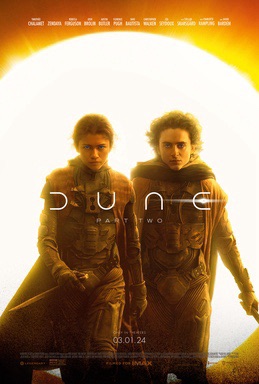
Well, everyone, today, we review the next installment in the newer film version of a franchise that has been based on a book series that began around 1965, with the first six spanning from 1965-1985, and there apparently being quite a few others after that. Timothee Chalamet, Zendaya, Rebecca Ferguson, and a few other people are back as their respective characters from the first movie. So now, let’s discuss Dune: Part 2.
Plot: After arriving on the planet Arrakis, and being reunited with his girlfriend, Chani (Zendaya), and the tribe, known as the Fremen, Paul Atreides (Timothee Chalamet) must now prevent a holy war from occurring, and the fate of his family, and loved ones from suffering a terrible fate. Will visions that he keeps having help him to do so in the end?
Ladies, and gentlemen, first of all, Hans Zimmer’s score is amazing for this film. I mean just as with animated films like The Lion King, Kung Fu Panda, and live action films like Inception, and Interstellar, he truly does know how to use his music to engage the audience very with this film. Truth be told, it’s really when any of the powerful moments occur that people are really bound to love the score for this film, be it the battle scenes, any scene that is more powerful, and uplifting, and scenes like those. Next, and most importantly, the storyline is really great. Honestly, considering that the first film felt a little more slow, and had a little too much put into it such as probably way too many characters even for a 2 1/2 hour movie, and had a little too much going on for it, it was nice to see more specific elements toned in on, including better world building, better character development, and more. Granted, some of the newer characters could have likely been developed a little better than they were. Still, they were still developed enough to be likable, and memorable. Also, the planet of Arrakis is really cool, almost like a potential Mars type of planet, but most likely inhabitable like Tattooine from Star Wars. It’s also interesting, considering that this film can likely have a Star Wars kind of feel in terms of the sci-fi feel, the fictional planets, and the designs of particularly the human characters. Additionally, the acting was really great, especially from Timothee Chalamet, Rebecca Ferguson, Zendaya, and others. You also have newcomers such as Florence Pugh, and Christopher Walken, joining the cast. Both have been great actors in the past, especially Walken. I mean, come on, can you ever go wrong with someone like him? Who hasn’t like him in roles that’s he’s been in in the past, be it one of the villains in one of the earlier James Bond movies, a character from Mouse Hunt, Blast From The Past, and Click to name a few? Well, he’s great in this film as well as Emperor Shaddam IV. Next, some of the creatures in this film were really cool, especially these creatures called sand worms. Honestly, if Warner Brothers had it’s own the park, I bet that if there was a 3-D ride of Dune, or roller coaster ride, or something along those lines that involved those creatures, that would likely be really cool. While watching this film, I’m not sure if other people who saw this film also felt this way, or not, but when I watched any scene that involved humans riding the sand worms, part of me felt myself wishing that I could have been transported into the film just to ride those things even for a few minutes, if not more. Well, then again, I’m sure at least a few, or even many other people who saw this film probably felt that way too? Well, if you’re reading this review, and felt that way as well, feel free to let me know either on this blog, and wherever else I post this review. Well, along with the sand worms, the rest of the visuals for this film are incredible. If this film didn’t have 3D showings, then it probably deserved to have those. This film could most definitely be incredible in 3D. Finally, the action sequences, including the fight scenes, were well choreographed.
But are there any negatives for Dune: Part Two? Well, yes, there is at least one. I know it may be somewhat hard to explain better without hopefully spoiling the film, or at least certain aspects of it. Basically, there was a point that occurred near the end of the film, where the main character, Paul, made a decision that, at least in this film, felt somewhat out of place, and hardly had a whole lot of buildup to that point in time in the film. And yes, it may have likely been a life-altering one not only for him, but all those around him. Again, not going to give away what that decision was. However, I do wonder if it was explained better in the novel why he did what he did. You got me! Maybe because this film was running closer to three hours, they couldn’t elaborate on that whole deal? Still, would it have hurt to make this film have a running time of three hours, or a little over to try go into a little more detail on that aspect? Just a thought! Maybe they will more in the future films. We shall see!
And that’s my review for Dune: Part Two. Though there were certain aspects, particularly near the end, that could have been elaborated on a little more, this film is most definitely a wonderful experience. And yes, definitely one more fun to see in theaters first before video, if you were to watch it multiple times. It has a story that was better developed than it’s predecessor, has a fun sci-fi, and Star Wars feel, has a wonderful score, likable characters, and more elements that make this film really fun to watch. If you like sci-fi, have at least seen Dune: Part One, and enjoyed that one, but have yet to see this second film, then all the more reason to see Dune: Part Two. You are bound to have just as much fun, if not more than you may have with the first film.
 Matthew’s Animated & Live-Action Movie Reviews