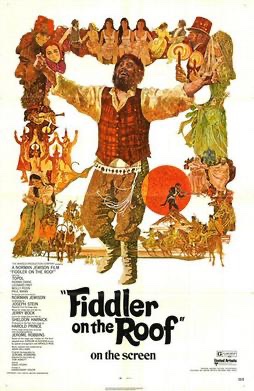
Alright everyone, we have finally arrived at another milestone mark. Today, much like with my 450th review, we are going to be reviewing another movie musical. And not just any musical, oh no! Much like The Sound Of Music, this one is also legendary, winning Academy Awards for Best Cinematography, Best Music, and Score, and Best Sound, as well as apparently also winning a couple Golden Globes for Best Motion Picture-Musical, or Comedy, and Best Actor in those same categories. Now, you may be wondering, will this start a trend where I make older musicals my milestone reviews from here on out? No, no! I wouldn’t go so far as to say something like that. Still, I had been wanting to rewatch, and review this particular film for a couple reasons. One is that it apparently reached it’s 50th anniversary as of around November of this past year. Second, I remembered enjoying this film as a kid, or teenager, and enjoying it, but wanting to see if I would enjoy it just as much, or more, or even less as an adult. Also, after hearing from many other people that saw it how much they loved it, I figured that it was only fitting that I make this one of those times that it ends up being part of the special reviews that is either in the hundreds, or hundred fifties, or something like that. So now, again, is this film just as good as I thought, or is it better, or even worse? Well, without further ado, let’s dive into what may be one of the most memorable movie musicals, from 1971, Fiddler On The Roof!
Plot: Set in the early 1900s, in Russia, when Jews still lived in little community villages for a time, a Jewish milkman named Tevye (Chaim Topol) lives with his wife, Golden (Norma Crane), and his five unmarried daughters Tzeitel, Hodel, Chava, Shprintze, and Bielke (played by Rosalind Harris, Michele Marsh, Neva Small, Elaine Edwards, and Candy Bonstein). Wanting at least three of his daughters married off, as they are of age, Tevye, and Golden attempt to devise a plan to do so, by having a Jewish matchmaker named Yente (Molly Picon) get them married off, since it is tradition to have arranged marriages. However, when certain men come into play that fall in love with either, Tzeitel, Hodel, or Chava, Tevye, and Golden must choose whether they will stick to tradition of arranged marriages, or if they will be the first people to let their children marry the man of their own choosing.
First off, I remember first watching Fiddler On The Roof during one of my years of being homeschooled. Of course I enjoyed it, despite not watching the film itself since then. Yes, I got to still hear a couple of the songs from it like “Matchmaker, Matchmaker,” and the iconic “If I Were A Rich Man,” during one of my high school years at Jim Elliott Christian Schools, as I was in a play in which those songs were performed, and my musical theater class performed songs from other musicals as well. But of course it’s not the same as seeing a musical in it’s entirety. Either way, I just confess this as well. After watching Fiddler On The Roof once before so many years ago, I remember seeing this movie, most notably when it came to the the characters, in black and white in terms who I believed the good guys to be, and who I thought the bad guys were. If I were honest, I probably might have seen other aspects of this film through those types of lenses as well. However, watching Fiddler On The Roof again years later, I was surprised to find that things were just not that cut, and dry when it came to films like Fiddler On The Roof. Sure that might have been the case when it came to certain similar scenes in a movie like An American Tail (which came out fifteen years after this film’s release). Still, not so much the case here. For example, when you have people in this movie, like the Cossacks, performing those things, known as pogroms, in the Jewish communities (for those of you who don’t know what those were, feel free to go look that up, or watch movies like Fiddler On The Roof, and An American Tail to get a visual of what they were), it is interesting to find that not all of them wanted to perform those, but were willing to anyway, as they knew that the situations would more than likely be worse otherwise. I could also go on about other aspects of this film, such as certain characters making choices that could potentially cause conflict in their families, and other aspects of this film too. However, let’s move on from there, and talk about the other aspects of Fiddler On The Roof. To begin, there are the characters. Wow, I can see why Norman Jewison, the director of this film, has this film be around three hours long. Each of these characters stand out incredibly, from Tevye, Golden, and their five daughters, to Lazar Wolf, butcher, the Rabbi, the poor tailor Motel Kamzoil, Perchik, the Bolshevik revolutionary, and of course, the Russian Constable. They are all so fleshed out that it would be hard to not to find one that could either a favorite, or even least favorite one. Hard to believe? Well, movies like Fiddler On The Roof, The Sound Of Music, and I’m sure many other films that were released back around this time period serve as great examples of why films of this caliber were so great in the first place. Next, there is the music! Holy cow, the songs are mostly, if not fully, memorable. “If I Were A Rich Man,” “Sabbath Prayer,” “Sunrise, Sunset,” “To Life,” “Miracle Of Miracles,” you’re more than likely going to have a good majority of these songs stuck in your head for a very, very long time. Seeing as Fiddler On The Roof has been performed at high schools, dinner playhouses, and other places of theater business over the years since this film’s release, that is most definitely saying something. How could this film not win any awards for it’s music? Seriously! Not to mention the amazing orchestra that is featured in some of the musical numbers in this film! Oh, and let’s briefly mention how Tevye most definitely have his all during any of his musical numbers, especially for “If I Were A Rich Man.” Additionally, it is amazing how this film depicts the Jewish culture as closely as possible. I mean you have the Jewish synagogues, Jewish artifacts, the small communities, the clothing, and of course the whole matchmaking process, among many other ways that this film portrays the Jewish culture. It’s also cool how different events of the Bible are briefly brought up at one point in this film. That is especially since, well, if people don’t know all that happened in the Bible, that may pique people’s curiosity, and know what happened with the Jews, and other foreign nations sometimes as well. And another thing! This movie will make you either laugh, or cry, even at unexpected moments. Even when some of the songs are sung, you’d be surprised to find yourself either cracking up real hard, or even feeling heartbroken for any characters that go through very tragic moments. Finally, it’s amazing how the Jews were willing to follow, and do God’s will as best they could. And yeah, how could we not mention that Tevye served as a great example about what it truly means to have a true relationship with God.
And that’s my review for Fiddler On The Roof. I’ll say it again, this film is phenomenal in every way. It has great music, excellent characters, taps the right emotions at the right times, and is overall really well done. If you want to see a movie like that, and that portrays the Jewish culture as accurately as possible, I would highly recommend that you see this film. Guaranteed that you’d find it hard not to enjoy this film to one degree, or another. Yes, it is three hours long. However, those three hours are well deserved for a film like Fiddler On The Roof. If you haven’t seen this film yet, make plans to do so whenever you can! You will more than likely be glad that you did afterwards.
Final Grade: A+
 Matthew’s Animated & Live-Action Movie Reviews